
TRINITY
An Ontology-based Agentic AI
development platform for executing complex tasks.
- Ontology-powered
- DataAnalysis
- Reasoning & Decision Support
- Agentic AI Development Platform


TRINITY is an Ontology-based Agentic AI development platform that allows you to develop AI Agents that understands the meaning and context of work, and autonomously perform tasks through analysis, reasoning, and decision-making. By structuring the enterprise’s vast data, business rules, processes, and know-how into an Ontology, the AI Agent can understand the company’s data and business rules, autonomously perform complex tasks. The AI Agent developed for specific tasks can be provided via interactive UI or API.
Ontology
What is Ontology?
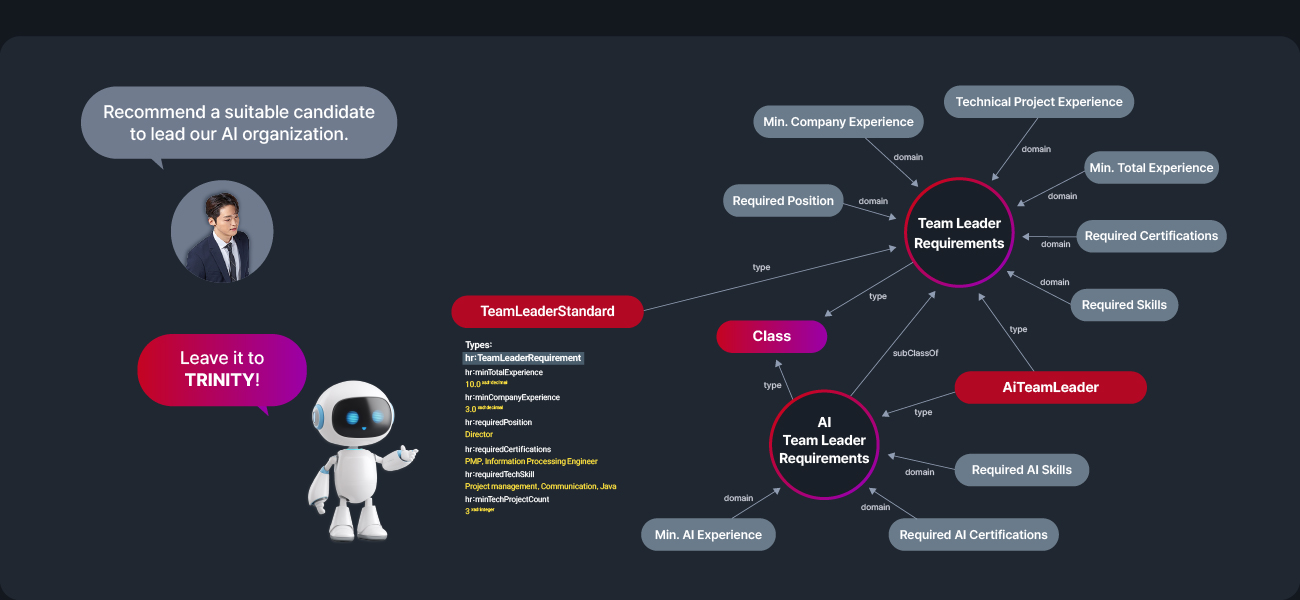
Ontology is a representation model that organizes the entities, attributes, and relationships into a knowledge structure so that a computers can understand not just the data itself, but its underlying concepts and meanings. By modeling a company’s business environment, including its data as an ontology-based digital twin, it becomes possible to clearly define the knowledge needed for an AI Agent to perceive the business environment in the digital realm, plan, and execute. This enables sophisticated analysis and reasoning that consider context and meaning beyond simple statistical analysis, and when combined with Agentic AI, allows rapid identification of cause-and-effect relationships within complex data to pinpoint the root causes of problems and suggest solutions.
TRINITY models this Ontology information into subject-predicate-object structures (RDF triples), reconstructing complex enterprise data into a format that AI Agents can comprehend. Based on company-specific Ontologies, the AI Agent grasps business logic and context, operates in alignment with actual decision-making workflows, and delivers sophisticated and reliable results that were difficult to achieve with conventional methods.
* RDF: A W3C Standard Model for Data Interchange on the Web

Ontology-based AI Agent Development Process with TRINITY
First, define the problem to be solved using the AI Agent, then proceed with the development and application through the following process.
1. Data Preparation (i-META)
- Prepare data to be used by the AI Agent through the following steps.

Raw Data Collection
Collect raw data from various sources such as ERP, CRM, DW, documents, etc.
Cleansing & Preprocessing
Handle missing values, treat outliers, standardization, etc.
Meaning-based Structuring
Define and classify the meaning of tables, fields, and attributes.


2. Ontology Configuration (Ontology Designer)
- Provides AI-powered automatic generation features that allow even users unfamiliar with Ontology syntax to create Ontologies.
Data Ontology
Generates a Data Ontology that defines the relationships between data elements based on the prepared data (i-META)
*Automatically generates a Data Ontology using the i-META structureKnowledge Ontology
Define rules for problem-solving based on the Data Ontology
* Users can define rules in natural language or upload business manuals and related documents. The system automatically generates a Knowledge Ontology based on the content


3. AI Agent Setup
- Specify the LLM model each Agent will use (support various LLM options).
- Assign the data source and Ontology model to be utilized by each Agent.
- Each Agent module perform tasks in a repeated Plan → Execute → Retry loop based on the assigned Ontology model.
Anomaly Detection Agent
(AnomalySentinel)
Root Cause Tracking Agent
(RootCauseTracker)
Recommendation Agent
(OntoRecommender)


4. Interface Implementation
- Define how the Agent’s results will be presented. (e.g., chatbot, visualization, report screen, etc.)
Natural Language Query UI
Provides a UI that analyzes natural-language questions and responds with inference/analysis results.
API Integration
Provides RESTful APIs to retrieve Agent results from the AUD platform or web environments.


Application Fields
TRINITY can be applied across all industries, aiming to revolutionize work productivity by utilizing AI Agents that perform various data-driven tasks.
Finance
- Risk management and anomaly detection through customer and transaction data analysis
- Automated loan screening: Integrated analysis of customer history, credit evaluation, regulatory documents
- Auto-generation of executive reports (financial indicators, P&L)
Manufacturing
- Quality Control: Automatic tracking of defect causes during the production process (Root Cause Analysis)
- Equipment Monitoring: Combining sensor/IoT data with work logs to enable predictive maintenance
- Automation of cost and efficiency analysis reports by project/process
HR & Organization Management
- Recommendation/Placement: Suggest suitable employees based on the career, training, and performance data
- Promotion/turnover risk analysis
- Automatic verification of qualification/experience when employees change roles (e.g., Staff → Technical Position)
Public/Government
- Policy-based answers derived from vast regulatory documents and legal data
- Automation of Civil Petition/Administrative Services: Natural language query → rule-based answers with sources
- Auto-generation of public project profit/performance analysis reports
Retail/Distribution
- Demand forecasting and inventory optimization based on sales and customer behavior data
- Auto-generation of promotion performance analysis reports
- Service improvement proposals based on analysis of customer complaints and VOC data
Corporate Management
- Auto-generation of analysis charts and reports for management meetings
- Provide consolidated dashboard of project progress. KPI achievement rates, risk metrics, etc., across departments/systems
- Integrate data scattered across departments/systems, and provide consistent enterprise-wide management indicators


